



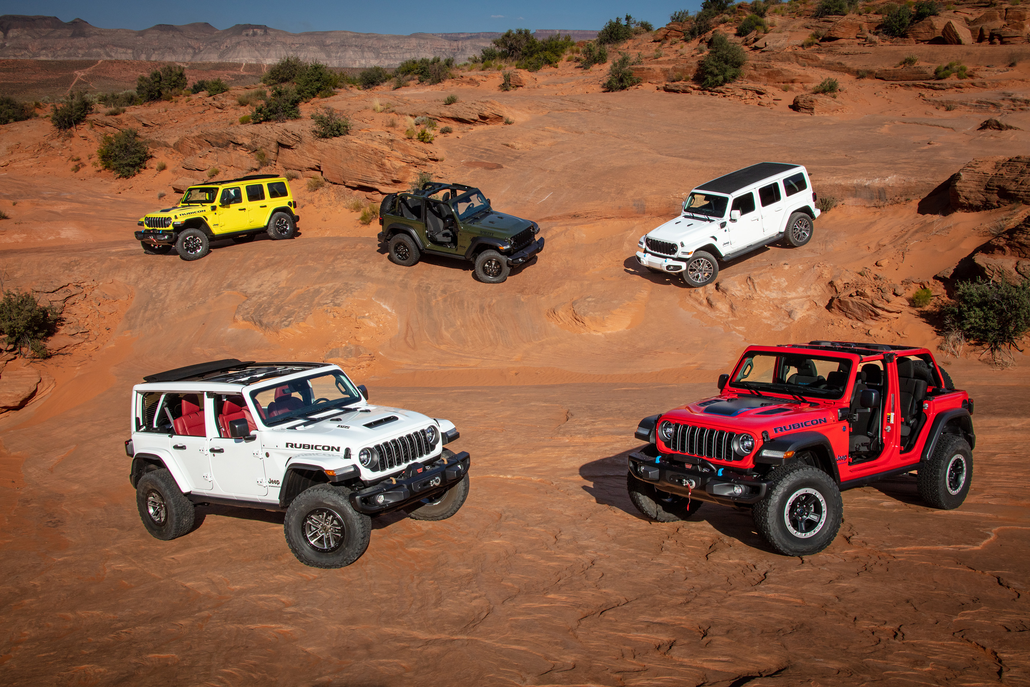
Comparison articles are common for automotive publications and websites, but you don’t often see a comparison of a pickup versus an SUV. The reason is apparent. Shoppers will likely know from the outset if they desire the non-height-restrictive, 270-degree cargo access, dirt and aroma-friendly aspect of an open bed, or the security of an enclosed cargo area. But, as in so many things, it can be different with a Jeep. The Wrangler and Gladiator have so many aspects about them outside of basic utility that Benna Chrysler Dodge Jeep Ram figures a comparison is in order.
Similarities
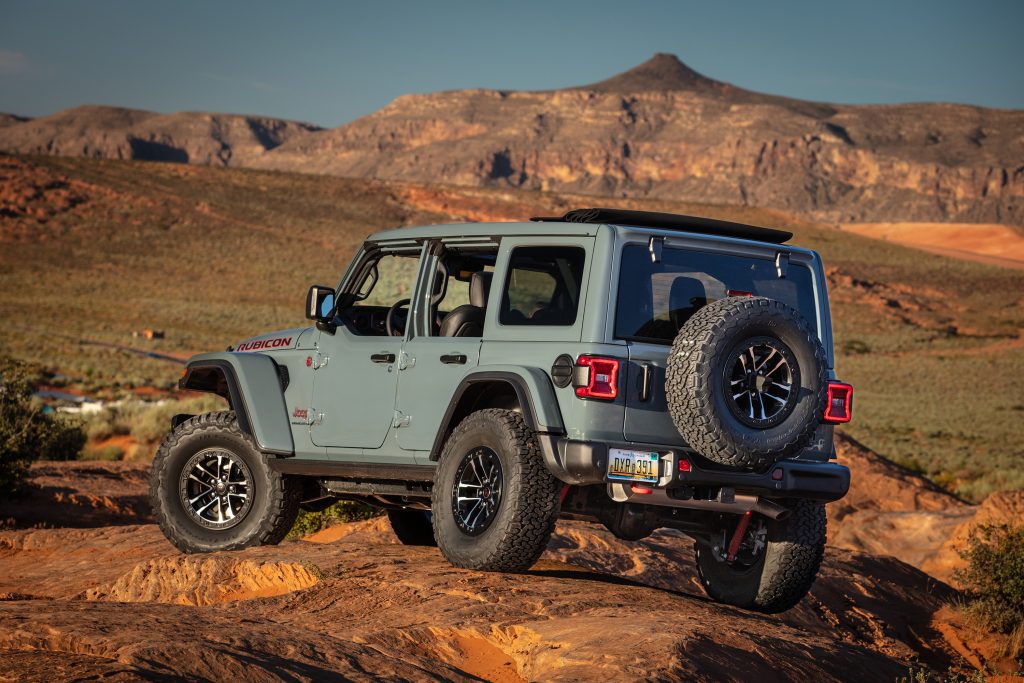
There are a lot of these. The Gladiator is basically a Wrangler with a 5-foot bed in the back. To accommodate the bed, the Gladiator stretches the Wrangler 4-door’s platform by almost 20 inches and is 30 inches longer overall. The passenger space is essentially the same, each providing the same impressive 38.3 inches of rear legroom and minimal, if any, differences in any other passenger space dimensions.
The JL Wrangler’s front end was changed to a shorter, rounded face to better accommodate a factory-installed front winch. The Gladiator continues with the previous JK Wrangler’s front styling, but the differences are primarily cosmetic and minor.
One Powertrain vs Four
Last year, Jeep sold three Wranglers for every Gladiator, allowing Jeep to make a business case for more Wrangler variations. The most significant differences are under the hood, where all Gladiators come with the 3.6-liter V6, which is shared across many Stellantis vehicles. It makes 285 hp and is novel in that it comes standard with a 6-speed manual transmission. The smooth-shifting 8-speed automatic is a $2,500 option. Fuel efficiency is not a calling card for either of these vehicles, and with the automatic, the Gladiator has an EPA-estimated city/highway/combined rating of 17/22/19. All three figures drop by one with the manual.
The Wrangler also has the same V6 and 6-speed manual as its standard powertrain, and being smaller, it is rated at 18/24/20 depending on the trim. However, the Wrangler has other options, starting with the 2.0-liter turbocharged inline-4, which has a similar 270 hp but greater torque of 295 lb-ft. It also bumps up the mpg a bit at 20/23/21. The efficiency champ is the Wrangler 4xe, a plug-in hybrid that takes the same 2.0-liter engine and pairs it with a 134-hp electric motor, producing a total system power of 370 hp and 475 lb-ft of torque, which is a lot of torque for a relatively small vehicle. The 4xe is also rated at 20 combined mpg but includes 22 miles of electric-only driving, which is great if you can charge at home (no special charger required) and your daily commute is close to or less than that amount. Or, maybe, you want to go off-road without disturbing the nearby critters.
For those of the “too much is never enough” school of thinking, there is the 6.4-liter (392 cu.in.) V8 on the Rubicon 392 that puts out 470 hp and 470 lb-ft. It will cover the 0-60 in a flat 4 seconds and the quarter mile in 12.8 seconds with the mpg penalty of 13/16/14, which assumes you are not drag racing.

Capability and Towing
The Gladiator’s long wheelbase makes it a more stable candidate for towing, with a maximum ability of 7,700 pounds. That is beyond the reach of any Wrangler. The Rubicon comes closest at 5,000 pounds, while other models are limited to 2,000 or 3,500 pounds.
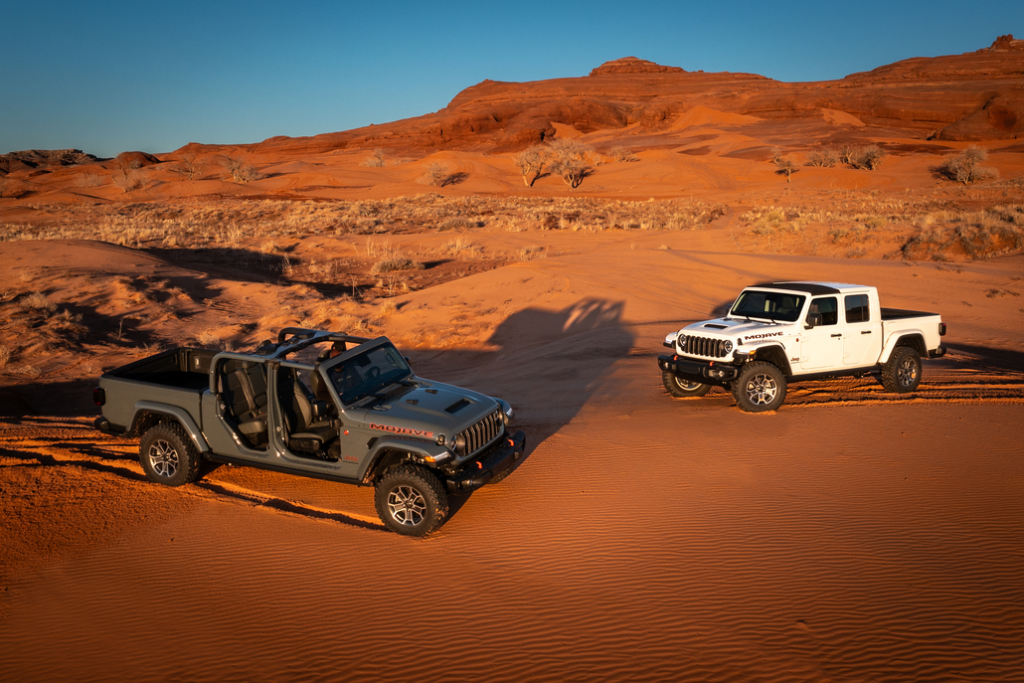
Both models come standard with the part-time Command-Trac 4WD system, which includes a 2.72:1 low range. Selec-Trac is a full-time system that automatically reverts to two-wheel drive on dry paved roads. The most off-road capable system is Rock-Trac, which has a 4:1 low ratio and can be used in both full-time and part-time forms. The Gladiator is no slouch, but the Wrangler wins as the most off-road capable vehicle, thanks primarily to its shorter wheelbase and rear overhang. The 2-door Wrangler is better still for the same reason. Both models have Rubicon and Mojave trim levels. True to the terrain of the places they are named after, the Mojave is built for high speed over rough surfaces. The Rubicon’s forte is slow-moving over very challenging surfaces. Each can cross over into the other’s lane to a lesser degree.
What’s Inside
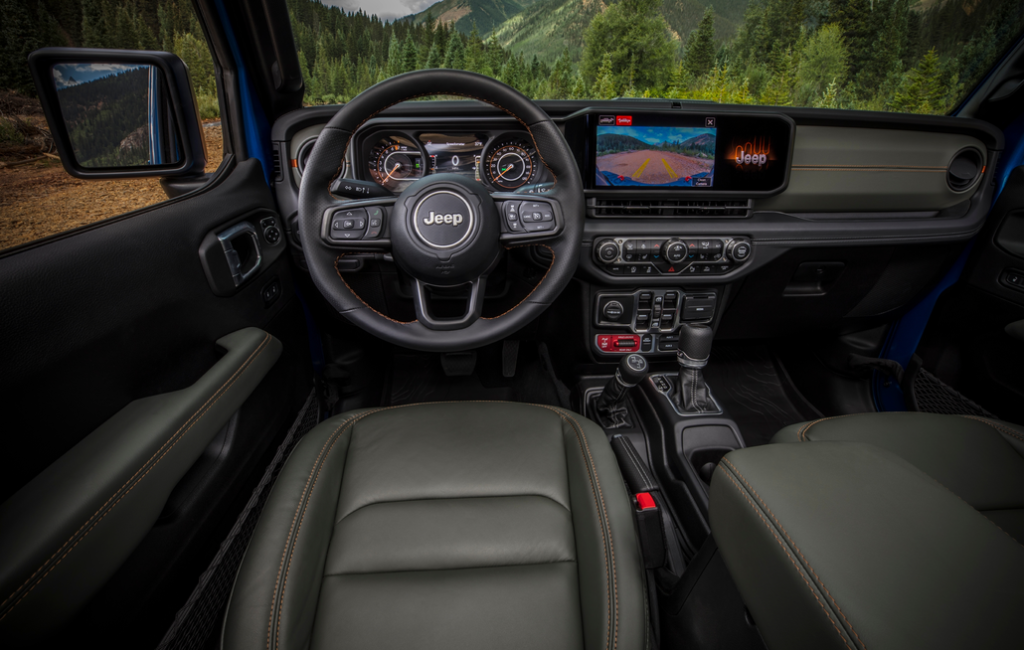
The Wrangler and Gladiator dashboards are not identical but similar in concept. They have a flat, upright presentation, large physical controls, and hard, easy-to-clean surfaces. Both offer a 12.3-inch touchscreen powered by the well-regarded Uconnect5 interface. 68 “Badge of Honor” trails are built into the navigation system, and more can be added.
Ultimately, it again comes down to how you plan to use your vehicle. Both are designed for play, but the Wrangler can generally play harder, while the Gladiator offers greater utility. Neither is like anything else on the road. To see the similarities and differences discussed up close, visit Benna CDJR and check out the Gladiator, Wrangler, and Wrangler 4xe for yourself.
Connect with us


Recent Blog Entries
- Jeep Wrangler vs. Jeep Gladiator: Which Fits Your Lifestyle?
- The HEMI® Is Back: Why Ram Brought Back the V8 in the 2026 Ram 1500
- Ram 1500 Reigns as MotorTrend 2025 Truck of the Year
- Chrysler Unveils Pacifica FAV Edition
- Wagoneer S and 1500 Ramcharger Among Newsweek’s Most Anticipated Vehicles for 2025